Care for Your Skin, Hair, and Nails
Comprehensive Dermatology Services
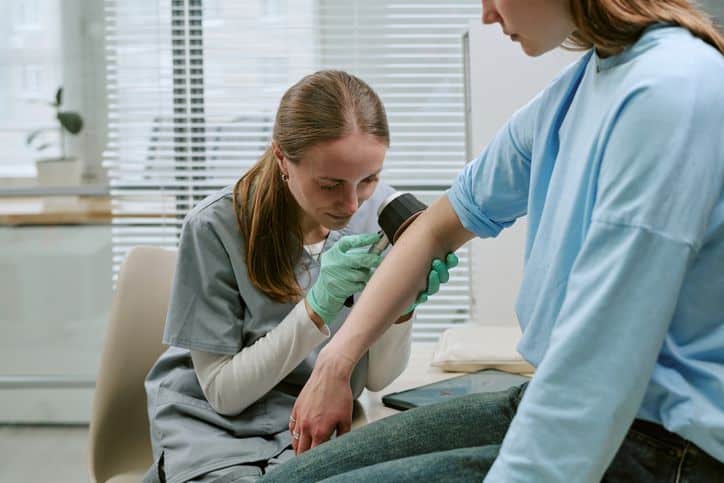
We offer a full range of dermatology services to diagnose and treat conditions affecting your skin, hair, and nails. Our dermatologists provide both medical and surgical treatment options, as well as resources to help prevent, detect, and treat skin cancer, the most common form of cancer.
We diagnose and treat a wide range of skin, hair, and nail conditions, including:
- Acne
- Alopecia
- Cold sores
- Dermatitis
- Moles
- Fungal infections
- Psoriasis
- Rosacea
- Skin Cancer
- Warts
Sun Safety & Skin Cancer
You’re never too young — or too old — to think about skin cancer. Most people diagnosed with skin cancer are age 50 or older, but because the disease is often linked to excessive sun exposure, everyone, including young children, should take steps to protect their skin. Fortunately, many skin cancers can be prevented or detected early, when treatment is often most effective.
Tips for Safer Skin
- Avoid the sun between 10 a.m. and 3 p.m., when the sun’s rays are the strongest
- Wear protective clothing such as long pants and a long-sleeved shirt, a wide-brimmed hat and sunglasses whenever possible
- Avoid tanning booths and beds
- Ultraviolet light from the sun and indoor tanning can cause skin cancer and premature skin aging.
- Wear sunglasses that block UV rays.
- UV-blocking sunglasses help protect both your eyes and the delicate skin around them. Research has shown that prolonged sun exposure without proper eye protection increases your risk of developing certain eye diseases.
- Know your skin and report anything unusual to your doctor.
- Watch for the ABCDE warning signs of melanoma: Asymmetry, irregular Borders, Color that is not uniform or is black, Diameter greater than 6 millimeters (about the size of a pencil eraser) and Evolving (any change in size, shape, or color).
Save Your Skin
Apply a broad-spectrum sunscreen with a sun protection factor (SPF) of at least 30 every two hours, and more often after swimming or sweating. People with fair skin, a family history of skin cancer, or frequent sun exposure are at higher risk for skin cancer and should take extra precautions. For the best protection, combine sunscreen with shade, a wide-brimmed hat, sunglasses, and other protective clothing.
Sunscreens are available in many forms; lotions, creams, ointments, gels, sprays, and wipes, to name a few. Some cosmetics, such as moisturizers and foundations, are considered sunscreen products if they contain sunscreen. Don’t forget about your lips; sunscreen also comes in lip balm form, and some lipsticks even contain sunscreen.